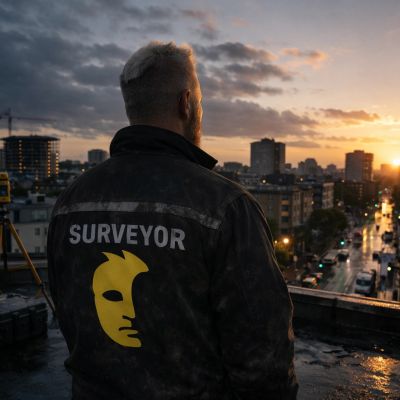
Final Thought

I will never put on a life jacket again!
What Does a Surveyor Look Like Today?
I don’t look like what people expect a surveyor to look like. I’ve walked into estate agents, introduced myself as the surveyor, and still been asked for ID. I’ve also had that moment where you can feel a judgement being made the second you speak in your natural voice. It’s rarely said out loud. Most of the time it isn’t. But you know it’s there. For me, it’s the accent. South East London. Direct. Not polished. Not what people traditionally associate with a professional voice. Add in appearance and manner, and I don’t fit the image many still have of a RICS surveyor. Having worked across a range of environments within the profession, I’ve seen this from multiple angles. And that’s where the conversation starts. Because the profession has changed, but in some places, the perception hasn’t quite caught up.
More Than the Mould
Surveyors today come from all backgrounds. Different voices. Different paths. Different ways of seeing the world. That should be one of the profession’s greatest strengths. But in practice, there can still be an unspoken expectation of what a surveyor is “supposed” to look or sound like. And when someone doesn’t fit that expectation, they can find themselves being assessed before their work is ever seen. The reality is simple: competence doesn’t have a postcode, an accent, or a dress code.
What Happens Behind the Scenes
And while perception shapes first impressions, workplace culture shapes long-term experience. In my experience, the biggest challenges are often not technical, but human. Pressure, hierarchy and personality all play a role in how people experience their working environment. Most issues are not obvious or extreme. They are subtle, cumulative, and often difficult to challenge. They can show up as: ● being overlooked ● being challenged in ways that are not always constructive ● or being made to feel like the problem Individually, these moments may seem small. Over time, they build.
When Pressure Becomes Personal
For me, it didn’t start with a breakdown. It started with not sleeping. Thinking about work constantly. Replaying conversations. Trying to make sense of situations that didn’t feel right but were hard to challenge. That kind of pressure builds quietly. And when it does, the impact goes beyond work. It affects how you think, how you feel, and how you function day to day. Eventually, I reached a point where I had to step away and engage with mental health support. That experience changed how I see the profession and how important it is that we take workplace culture seriously.
After a Diagnosis
One of the less talked about aspects of mental health in the workplace is what happens after a diagnosis. Support exists, and that is important. But alongside that, there can be a shift in how a person is perceived. Communication can become more complex.
There is a risk that:
● concerns are interpreted through the lens of a condition
● rather than being considered on their own merit
And that can make it harder, not easier - for someone to feel heard. This is not about blame. It’s about awareness. Because understanding this dynamic is key to supporting people properly.
A Profession That Works for People
The surveying profession has always been about standards, integrity, and responsibility. Those same principles should apply to how we treat each other. That means:
● looking beyond stereotypes
● recognising talent in all forms
● and creating environments where people can do their best work without unnecessary pressure
Because when people are supported properly, the quality of the work follows.
Final Thought
A good surveyor isn’t defined by how they sound, how they look, or whether they fit a traditional mould. They’re defined by what they do. Maybe it’s time we started judging the survey, not the suit.
The Beginning: Belonging
A young man stands among his peers, surrounded by applause, energy, and acceptance.
At university, he is not judged by his voice, his appearance, or where he comes from.
He is seen for what he is - capable, driven, and human.
For a moment, the world feels fair.
There is no barrier between him and opportunity.
No quiet doubt in the room.
No need to prove himself beyond his work.
Just potential.

The Reality: Alone at the Desk
Years later, the same man sits alone late at night. No reception desk. No admin team. No polished corporate structure. Just one man - a surveyor, a father - trying to build something that works. The light is dim. The work is constant. He carries everything - the reports - the clients - the responsibility - the pressure There is no applause here. Only endurance

Resistance: The System Pushes Back
His work is good. Accurate. Honest. Uncompromising. But that comes at a cost. Estate agents begin to resist him. His reports don’t serve their interests - they serve the truth. Quietly, things start to change. Phone calls go unanswered. Instructions disappear. Opportunities fade without explanation. Behind the scenes, something shifts. Not because of his ability - but because of what his work represents.
The Judgement: Before a Word is Spoken
He walks into a room and introduces himself as the surveyor. There is a pause. Not long. But long enough. A glance. A second look. A subtle question behind the eyes: “Is he really the professional?” His accent lands before his credentials. His appearance speaks before his work is even considered. He feels it. Not said. But understood.
The Undermining: Value Reduced
The conversation shifts. The work is no longer the focus. Instead - the fee is questioned - the price is pushed - the value is negotiated down Not based on the service. But based on perception. He is treated less like a professional and more like someone to bargain with. The comparison isn’t spoken. But it’s there. And it cuts deeper than the words themselves.
The Breaking Point: The Fall
Pressure builds quietly. Long hours. Constant proving. Unseen resistance. Unspoken judgement. Until one moment a simple movement, slightly rushed A step missed. The body gives way where the mind would not. The fall is physical. But it represents something far greater. The cost of carrying too much, for too long, alone.
The Collapse: Aftermath
Everything slows. Work stops. Income disappears. The structure that held everything together collapses. The consequences are not just professional. They are personal - financial strain - family pressure - loss of identity - loss of self-respect - The silence becomes heavier than the noise ever was.
The Darkest Moment
At his lowest point, the weight becomes unbearable. This is not about weakness. It is about exhaustion. The accumulation of - pressure - judgement - isolation - and the quiet erosion of worth It reaches a point where continuing feels harder than stopping. And that is where the story could have ended.
The Meaning
This is not just one man’s story. It is a reflection of something wider. A system where: - perception can outweigh truth - difference can be misunderstood - and people are judged - before they are seen - But it is also a story of awareness. Because once seen clearly - it cannot be unseen.